Ravda, Bulgaria: The Quiet Family Village Next Door to Nesebar (2026)
Updated August 15, 2026 · 8 min read
Ravda is the Black Sea village Bulgarian families pick when they want the same sand as the big resorts without the noise that comes with it. It sits 3 km from Nesebar's old town and 5 km from Sunny Beach — close enough to walk to a UNESCO World Heritage Site for dinner, far enough away to sleep afterward. Consider it if you want a shallow, family-friendly beach, apartments mostly between €50,000 and €125,000, and an actual year-round village underneath the tourism. Skip it if you want nightlife, resort polish, or serious rental yield — Ravda offers none of the three, and from November to April the place is, honestly, half-empty.
What it's like
Ravda is a village of about 2,500 permanent residents at the 2021 census, with recent estimates between roughly 3,100 and 3,800 — one of the few Black Sea villages where the year-round population is actually growing instead of melting away. Administratively it belongs to Nesebar municipality in Burgas province, strung along the E87 coastal road between Aheloy and Nesebar.
The modern village was largely settled after 1924 by Bulgarian refugees from Aegean Macedonia, and it kept a spine the purpose-built resorts never had: a school, a kindergarten, a library, a church, a 2,000-seat municipal stadium, and a decades-old tradition of children's and student summer camps. The National Sports Academy still runs its water-sports training base here (sailing, rowing, kayaking), football clubs come for pre-season camps, and there is even a Ravda Peak in Antarctica named after the place. In summer the streets fill with Bulgarian families, European retirees and kids' camp groups. One disco opened in 2025; there is no bar strip and nobody is planning one.
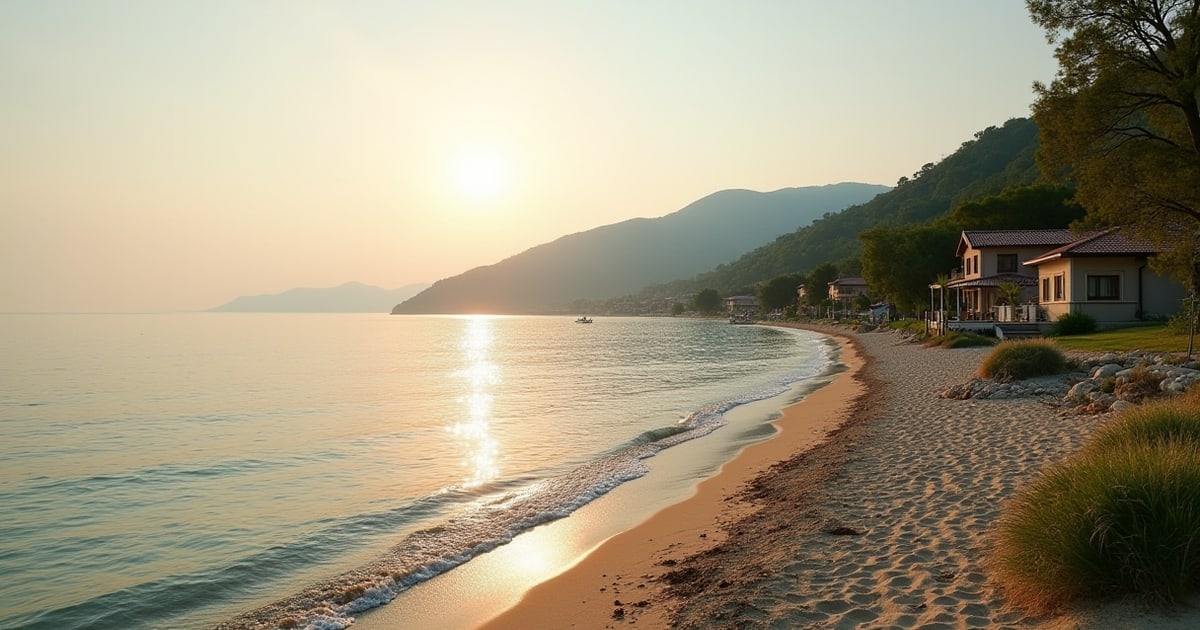
The beach is the main event: around 57,000 m² of fine golden sand in two sweeping bays separated by Cape Ravda and the old fishing pier. The main South Beach runs about 500 m and shelves gently into shallow water — genuinely good for small children, with lifeguards and sunbeds in season. The cove toward Nesebar is a long-standing windsurfing spot with a school that runs adult lessons and children's camps, and Aquapark Nessebar — about 46,000 m² of slides and pools — sits right at the edge of the village. The beach doesn't carry a Blue Flag, though the Aheloy–Ravda–Nesebar coastal waters are protected as a Natura 2000 site.
The honest downside you'll notice on day one: cranes. Ravda has a heavy new-build pipeline, and the empty plot between your balcony and the sea may not stay empty.
The season — and what winter is really like
The season runs June to mid-September, peaking in July and August when the sea averages around 22°C and every apartment in the village seems to be occupied by a Bulgarian family with two kids and an inflatable flamingo. It's lively without being loud — the evening promenade, not the foam party.
Then it stops. From November to April the tourist strip shuts, most restaurants close, and the streets empty out. This is the part glossy listings skip, so here it is plainly: in January, Ravda is a quiet village where you will know the cashiers by name because there are three of them.
What saves it is that real people live here. The supermarkets, pharmacies, greengrocers and everyday shops in the centre stay open all year, and the school, kindergarten, library and church keep running. That is more winter life than Sunny Beach or Sveti Vlas can offer — their complexes go dark — but noticeably less than Nesebar's new town or Pomorie. Bus frequencies drop, days are short, and you'll drive to Burgas for anything beyond groceries. If your idea of coastal living includes a lively February, look elsewhere; if you want quiet with a functioning village core, Ravda winters better than almost any resort-adjacent option on this stretch of coast.
Property: buying and renting (2026 prices)
Ravda's pitch is simple: real coastal prices a step below neighboring Sveti Vlas (€1,200–2,000/m² there), with a village attached. Figures below are cross-checked from live imoti.net listings (August 2026: 231 one-bedroom and 97 two-bedroom listings), bulgarianproperties.com agency listings, and 2026 market aggregates.
| What | Typical 2026 price |
|---|---|
| Mainstream apartments | €1,000–1,800 per m² (median around €1,200–1,300) |
| Seafront and luxury new builds | €1,800–3,500 per m² |
| Resale studios in decent condition | €25,000–40,000 |
| One-bedroom apartments | €50,000–80,000 |
| Two-bedroom apartments | €77,000–125,000 |
| New townhouses and villas | €157,000–264,000 (about €1,500–1,900 per m²) |
| Maintenance fees in gated complexes | €8–12 per m² per year |
| Long-term rent, studio to 2-room | €250–500 per month |
Rough studios in tired 2000s resort complexes still trade at €15,000–20,000. They're cheap for a reason: dated builds, patchy management companies, and complexes that are dead ten months a year. At the other end, a lot of what's for sale is off-plan with Act 16 (the occupancy permit) due in 2027–2028, sold on installment plans of 20–30% down with the balance in stages. Off-plan works here, but vet the developer and accept that the view from your window may change. Buildings advertised "without maintenance fee" are a common Ravda selling point — ask who actually pays for the roof before treating that as a bonus. The mechanics of ownership are covered in our guide to buying property in Bulgaria as a foreigner: apartments carry no nationality restrictions, while a house purchase involves land — direct ownership for EU citizens, a Bulgarian-company route for most non-EU buyers.
Two more honest notes. First, don't buy here for holiday-rental yield: tourists search for "Sunny Beach," not the village next door, so occupancy is lower and nightly rates run a moderate €30–100. Buy for your own use. Second, a modest genuine long-term rental market does exist — roughly €250–500 per month for a studio to two-room flat — which makes renting for a year first a realistic way to test a winter before you commit. The euro changeover didn't produce a price shock, but analysts forecast 5–10% Bulgarian housing growth in 2026, so waiting isn't free either.
Everyday practicalities
For daily life, the village covers the basics and Burgas covers the rest. Small supermarkets and greengrocers in the centre run year-round, the nearest Lidl is about 2 km away toward Nesebar, and big-box shopping means a trip to Burgas.
Healthcare is the real gap: Ravda has pharmacies but no medical centre. The nearest clinics are in Nesebar and Sunny Beach (3 km), and hospitals are in Burgas, about 30 km away. That 30 km is nothing for a routine check-up and a very long way in an emergency — factor it in seriously if anyone in the household needs fast access to care.
For families, Ravda is unusually well equipped for a coastal village: its own primary school and kindergarten, plus a library (chitalishte) with kids' arts and dance clubs. Secondary schools are in Nesebar, Pomorie or Burgas. Run your monthly budget through our cost of living calculator — village-coast living here costs meaningfully less than Sofia, and most of your big line items (groceries, utilities) are standard Bulgarian prices, not resort prices.
Getting there and around
Burgas Airport (BOJ) is about 20 km away — 25–35 minutes by car or taxi, and there's a cheap bus connection via Sarafovo for a couple of euros. Bus line 11 (Nesebar–Ravda–Aheloy–Pomorie–Burgas) stops in the village; in season, buses also run roughly every 20 minutes to Nesebar and Sunny Beach and every 30–40 minutes to Burgas.
Nesebar old town is a 20–40 minute walk along the coast, or 8 minutes on the bus — one of Ravda's best features, because you get UNESCO-town restaurants and winter services without paying Nesebar prices. Off-season, bus frequencies drop, so most year-round residents keep a car; see our guide to driving in Bulgaria for licenses, vignettes and imports.
Who it suits
- Families with young children: shallow gently-shelving beach, a water park next door, a school and kindergarten in the village, and a summer culture built around kids' camps.
- Buyers with €40,000–100,000 who want a coastal base for their own use, walkable to a real town.
- Year-round settlers who want Bulgarian neighbors rather than an expat bubble — there are long-term British and Russian-speaking owners here, but noticeably more Bulgarian families than in the resorts.
- Watersports people: the windsurfing cove and the Sports Academy base give it an active, unpretentious sporting streak.
Who should skip it: anyone who wants nightlife (that's Sunny Beach, 5 km up the road), anyone buying for rental income, and anyone who needs a town that stays awake in January — Pomorie, Burgas or Nesebar's new town do winter better. For the broader trade-offs of village-coast living, see living on the Bulgarian coast.
FAQ
Can you live in Ravda year-round?
Yes — over 3,000 people do, and the number is growing. Supermarkets, pharmacies, the school and the kindergarten stay open all winter. But restaurants close from November to April, there's no medical centre in the village, and you'll want a car. It suits people who like quiet; it will bore people who don't.
How much does an apartment in Ravda cost in 2026?
Mainstream apartments run €1,000–1,800 per m². One-bedrooms mostly sell for €50,000–80,000 and two-bedrooms for €77,000–125,000. Rough studios in older complexes start around €15,000–20,000, but inspect carefully before touching that end of the market.
Is Ravda better than Sunny Beach for families?
For living or owning, usually yes: quieter streets, a shallower and calmer beach scene, more year-round Bulgarian families, and no club noise. Sunny Beach wins only on nightlife and holiday-rental demand.
How far is Ravda from Nesebar and Burgas Airport?
Nesebar old town is 3 km — a 20–40 minute walk along the coast or 8 minutes by bus. Burgas Airport is about 20 km, or 25–35 minutes by car.
Can foreigners buy property in Ravda?
Yes. Apartments have no nationality restrictions at all. For a house it's the land underneath that matters: EU passport holders can own the plot outright, while non-EU citizens generally register a Bulgarian company to hold it. The full mechanics are in our property buying guide.
Sources
- Wikipedia: Ravda
- City Population: Ravda census and estimates
- imoti.net: Ravda apartment listings, August 2026
- BulgarianProperties: Ravda listings
- Investropa: Bulgaria housing prices 2026
- Egoist Estate: Ravda — the quiet alternative
- BeachBulgaria: Ravda beaches
- Burgasbus: line 11 schedule
- National Sports Academy: Ravda training base
- Ravda municipality info
- Wikipedia: Aquapark Nessebar
Got a question this guide didn't answer? Ask the community — we reply to every question.