Sunny Beach (Slanchev Bryag), Bulgaria: The Honest Guide (2026)
Updated August 15, 2026 · 8 min read
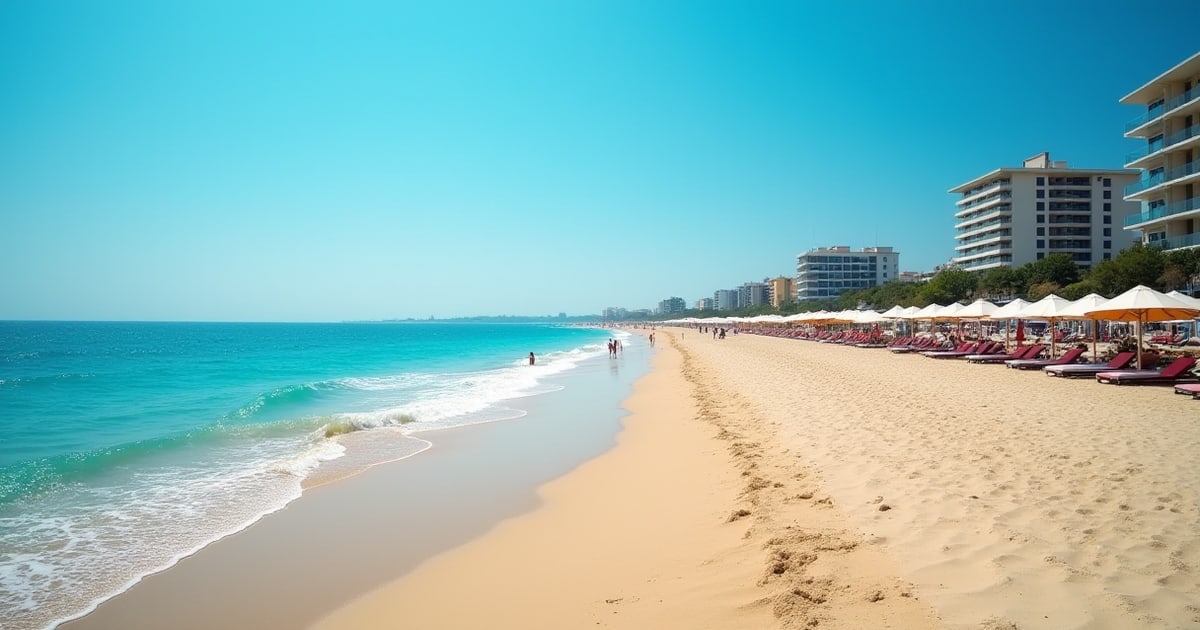
Sunny Beach is not a town. It is Bulgaria's biggest purpose-built resort — a roughly 6 km strip of hotels, holiday complexes, and bars that runs at full throttle from May to September and then shuts down almost completely. It also has the cheapest apartment stock in the country: habitable studios list from under €30,000, and distressed resales go far lower. If you want an inexpensive lock-up-and-leave summer base 27 km from an airport, or you understand exactly what an 8–10-week rental season does to yield math, keep reading. If you want a year-round community with schools, neighbors, and a working high street in January, skip this one and look at Nesebar, Ravda, or Sveti Vlas instead.
What it's like
Sunny Beach was created by government decree in 1958 on empty dunes, with the first hotel opening in 1959 and some 300,000 trees planted around it. Administratively it still isn't a town — it's a "settlement formation" inside Nesebar municipality, with an official year-round population close to zero. What exists is infrastructure: hundreds of hotels and apartment complexes holding tens of thousands of hotel beds, plus a comparable stock of privately owned holiday apartments, most of them built in the 2005–2008 boom.
The beach is the reason any of it exists: about 6 km of fine golden sand, averaging some 60 m wide, with a legally protected dune belt at the northern end. Both the central and northern beaches held Blue Flag status in 2025. The resort's other identity is the party strip — Flower Street, Cacao Beach's DJ pool parties, the clubs that earned Sunny Beach BBC and Channel 4 documentaries about young tourists behaving badly. That reputation is commercially real: it packed the resort in the record 2025 season, when hotels ran above 90% occupancy at peak. It's also why apartments near the strip are simultaneously the cheapest to buy and the hardest to actually live in.
Merged onto its southern end, about 3 km away, sits UNESCO-listed Nesebar — the real town, with the municipal administration, schools, clinics, and year-round shops that Sunny Beach itself does not have.
The season — and the six dead months
Hotels and bars open in late April or May and close by mid-October. July and August are loud, crowded, and expensive by local standards; June and September are the genuinely pleasant months.
From November to April the resort is shut. Not quiet — shut. Virtually every hotel, club, and shop on the strip is boarded up, along with 90-plus percent of the restaurants. What remains is a skeleton: a few supermarkets on the western and Nesebar side (the Mladost and Janet area), a pharmacy, a handful of places serving locals, and buses at reduced frequency. Street lighting and upkeep in the interior of the complex zone are minimal, and many buildings switch off water and heating in common areas. A residual community of a few hundred to low thousands overwinters — owners, pensioners, seasonal workers — clustered in the few winterized complexes near the working infrastructure.
If year-round living is your plan, visit in January before you sign anything. Our guide to living on the Bulgarian coast covers the winter shutdown across the smaller towns too, but nowhere is the summer–winter contrast as extreme as here.
Property: buying and renting (2026)
Sunny Beach is the cheapest apartment market in Bulgaria, and the reason is oversupply. The 2005–2008 construction wave left hundreds of complexes competing for the same short season, and fifteen-plus years of deferred maintenance now shows in the older ones. In 2026 the resort averages roughly €1,100–1,800 per m², with live listings spanning about €1,080–2,460 per m² depending on distance to the sea, building condition, and management.
| Zone / type | 2026 asking prices |
|---|---|
| Resort average per m² | €1,100–1,800 |
| Studio, "Golden Mile" (0–300 m from the sea) | from €49,000 |
| Studio, center (500–800 m) | from €38,000 |
| Studio, western zone (1–1.5 km) | from €29,500 |
| Studios in older complexes, bottom of the market | €12,000–28,000 |
| One-bedroom, typical listing range | €48,500–133,500 |
| Two-bedroom | €59,000–196,900 |
| Maintenance fee (mandatory) | €8–15 per m² per year |
| Long-term rent, one-bedroom | €280–510 per month |
The cheap stock is cheap for reasons you must price in. Every complex charges a mandatory annual maintenance fee — typically €8–15/m², so €500–900 a year for a 60 m² one-bedroom — payable whether you ever visit or not, and indexed upward most years. Older buildings with high fees and tired common areas are hard to resell; agents are known to show photos from when the complex was new. Off-plan buyers should know prices rise up to 30% between foundation stage and Act 16 (the use permit), so the discount for buying early is real but so is the completion risk.
The rental math deserves its own honesty check. The effective short-let season is 8–10 weeks, private-rental occupancy peaks around 68% even in July–August, and management companies take about 20% of revenue. Worked examples from 2026 land at roughly 3–3.5% net — a €54,000 studio clearing around €1,700 a year. The 5–7% figures agencies advertise apply to first-line, professionally managed units with maximum occupancy, not to the average fifth-line studio. Typical nightly rates run about €66 for a studio in high season and €41 in the shoulder months.
Who's buying in 2025–26: Poles, Israelis, Czechs and Slovaks, Germans, Ukrainian families, and Bulgarians. The British and Irish owners of the 2007 wave are net sellers, citing rising fees and management hassle. Coastal prices still rose 7–9% in 2025 and analysts forecast 5–8% annual growth near-term — but resort stock sells slower and sits emptier than city property, so treat appreciation as a bonus, not the plan.
There are essentially no houses inside the resort; for those, look at the villages behind it, like Kosharitsa, where gated-complex villas start around €149,900. The purchase process itself is standard — our guide to buying property in Bulgaria as a foreigner walks through it, including the apartment-versus-land distinction that matters for non-EU buyers.
Renting first is the smart move, but the long-term market is thin: one-bedrooms run about €280–510 a month off-season, and owners switch to nightly rates in summer, so genuine 12-month leases are scarce. See renting long-term in Bulgaria for how leases work.
Everyday practicalities
Supermarkets — Mladost, T-Market, Janet, and MM — serve the area more or less year-round, which is why permanent residents deliberately buy on the western and Nesebar side near them. Big-box shopping and malls are in Burgas, about 35 km away.
Healthcare is seasonal in the resort itself: private walk-in clinics operate in summer, and a central pharmacy runs on Flower Street. Year-round, the nearest care is Nesebar's municipal health house and private practices; anything serious means Burgas hospitals, roughly 35–40 minutes away. There is no hospital in Sunny Beach.
There are no schools. Nesebar has a kindergarten and schools; the real choice of schools is in Burgas. Families with school-age children overwhelmingly settle in Nesebar, Ravda, Sveti Vlas, or Burgas rather than the resort.
One more thing property ownership does not buy you: the right to stay. If you're a non-EU citizen planning more than tourist visits, run your situation through the residency wizard first.
Getting there and around
Burgas Airport (BOJ) is 27 km away — about 30 minutes by taxi (€25–30), €8 by shared shuttle, or €3 on the public bus, which takes 45–50 minutes and runs roughly 06:10–20:20 daily in season. The Burgas–Nesebar–Sunny Beach bus runs every 30–40 minutes in season and keeps going at reduced frequency all winter. Nesebar old town is a short bus hop or a half-hour walk along the merged shoreline. Varna is about 90 km north; Sofia is around 400 km.
In summer you walk — the resort is flat and pedestrian. For winter living a car is close to essential, both for Burgas runs and because local services thin out; see driving in Bulgaria for licenses and car costs.
Who it suits
Nobody sensibly buys Sunny Beach as their primary, standalone home. The four buyer cases that actually work: a cheap lock-up-and-leave summer flat for your own use; a short-let investment on the first line, entered with 3–3.5% net expectations rather than brochure numbers; a budget year-round base for pensioners or remote workers who genuinely don't mind ghost-town winters and pick a winterized complex near the Janet/Mladost side; or a low-cost landing pad near Burgas while you figure out where in Bulgaria you actually want to live.
Skip it if you need community, schools, quiet summers, or a liquid resale market. The same coastline offers all of those a few kilometers away — at higher prices, which is exactly the point.
FAQ
Why are Sunny Beach apartments so cheap?
Oversupply. Thousands of 2005–2008-era holiday flats compete for an 8–10-week season, every owner pays €8–15/m² in annual fees regardless of use, older complexes carry deferred maintenance, and units near the party strip trade at a further noise discount. Low prices are the market working, not a secret bargain.
Can foreigners buy property in Sunny Beach?
Yes — apartments are straightforward for any nationality, and EU citizens can also buy houses with land. Non-EU buyers face restrictions on land specifically. The process and pitfalls are covered in our buying property guide.
Can you live in Sunny Beach year-round?
A few hundred people do. It requires picking one of the handful of winterized complexes near the western/Nesebar side, owning a car, and accepting that from November to April your neighborhood is mostly boarded up. Most year-round coast dwellers choose Nesebar, Ravda, or Sveti Vlas instead.
What rental yield is realistic?
About 3–3.5% net for a typical unit after the management company's ~20% cut and the maintenance fee. The 5–7% agencies advertise applies only to first-line, well-managed complexes at maximum occupancy.
How far is the airport?
Burgas Airport is 27 km — €25–30 by taxi, about €3 by public bus (45–50 minutes). That convenience is one of the resort's few unambiguous advantages for owners flying in for short stays.
Sources
- Wikipedia — Sunny Beach
- BulgarianResales — Bulgarian property market: real prices and trends, early 2026
- Bolgarskiy Dom — Sunny Beach prices by zone
- Suprimmo — Sunny Beach property listings
- BulgarianProperties — Sunny Beach listings
- Mieszkania-Bulgaria — Sunny Beach 2026 prices and real rental profitability
- BulgarianProperties — Holiday property: dream or burden (maintenance fees)
- Money.bg — Sunny Beach hotels exceed 90% occupancy in 2025
- Burgas Bus — Burgas–Sunny Beach timetable
Got a question this guide didn't answer? Ask the community — we reply to every question.