Nesebar, Bulgaria: Living in a UNESCO Town That Works Year-Round (2026)
Updated August 15, 2026 · 8 min read
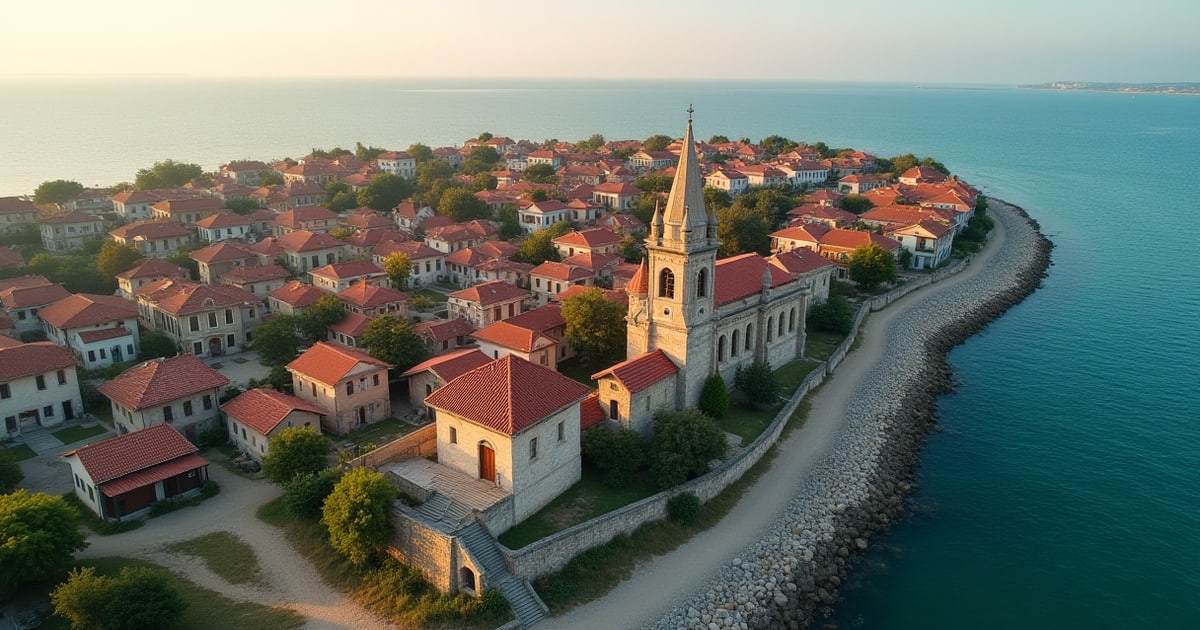
Nesebar is two towns wearing one name. On a rocky peninsula sits the UNESCO-listed old town: some 3,200 years of history packed into 850 by 350 meters of cobbled lanes, Byzantine church ruins, and timbered National Revival houses. Across a narrow man-made causeway — the one with the wooden windmill — spreads the mainland new town, where roughly 11,000-14,000 people actually live all year, with schools, pharmacies, a medical center, and supermarkets that don't close in October. If you want a coastal base with real services and an airport 35 minutes away, and you can tolerate a genuine tourist crush from June through September, Nesebar belongs on your shortlist of small towns on the Bulgarian coast. If you're picturing a sleepy fishing village — or you plan to live on the postcard peninsula itself through the winter — this probably isn't your town.
What it's like
The old town has been a national architectural reserve since 1956 and a UNESCO World Heritage Site since 1983. Legend says it once held 40 churches; about ten survive, including the frescoed St Stefan, the 5th-century St Sofia basilica, and the striped-brick Christ Pantocrator, plus an archaeological museum and an ethnographic house from 1804. It's genuinely spectacular — and in July and August it absorbs thousands of day-trippers daily, so every lane fills with souvenir stalls and tavern hosts waving menus. Beautiful, yes. Peaceful, no.
The new town is where life actually happens. Its residential quarters — Cherno More 1, 2 and 3, Aurelia, Nov Grad — mix ordinary Bulgarian apartment blocks with holiday complexes left over from the 2005-2014 resort boom. South Beach, the long, wide strip of fine sand below the isthmus, runs south toward Ravda behind a belt of dunes and is noticeably calmer and more family-oriented than the party strip at Sunny Beach, which has physically merged with Nesebar's northern edge. On that edge you'll also find the Aqua Paradise water park.
The foreign community reflects the boom years: a large Russian- and Ukrainian-speaking owner base, a strong Polish, Czech, and Slovak presence, and a contingent of British owners. Most are seasonal; the year-round expat core is smaller but real. The town's calendar peaks on August 15, the Assumption of the Virgin — the old town's patronal feast — alongside a summer run of arts and children's festivals.
The season — and what winter really looks like
The season runs late May to late September, and its scale is hard to overstate. Nesebar Municipality (29,333 people, including Sveti Vlas, Obzor, Ravda, and the Sunny Beach resort) holds around 150 hotels with roughly 70,000 hotel beds plus another 35,000 in private accommodation — more than three tourist beds for every permanent resident. In the first week of October, most of it switches off.
Here is the honest winter picture. From October to April the peninsula feels near-deserted: the restaurants and guesthouses shut, a handful of locals' taverns stay open, and the wind comes straight off the sea. January daytime temperatures hover around 7°C; snow falls some years but rarely lasts. Meanwhile the new town keeps functioning — supermarkets, pharmacies, schools, buses, and municipal offices all run year-round, because that's where the residents are. This is Nesebar's real advantage over Sunny Beach next door, which effectively closes at the end of September.
Functioning is not the same as lively, though. Winter evenings are quiet, the dining scene shrinks to a few local spots, and you'll drive to Burgas for a mall, a cinema, or a big hospital. With 2,100-2,200 sunshine hours a year the off-season is milder than most of northern Europe, but if you need buzz around you, budget for five subdued months.
Property: buying and renting (2026)
Nesebar prices sit slightly above most other Black Sea towns. Live 2026 listings put mainstream complexes at roughly €1,300-2,300 per m2, with the broad market band at €1,000-2,000 and first-line waterfront reaching about €3,500. For context, early-2026 market data puts average prices around €1,700/m2 in Burgas and €1,900/m2 in Varna — Nesebar brackets the former and its waterfront beats both.
| Property type | 2026 asking range |
|---|---|
| Studio | €49,500-95,000 (from ~€20,000 in aging complexes) |
| 1-bedroom apartment, mainstream | €60,000-135,000 |
| 1-bedroom, first line / sea view | €200,000-300,000 |
| 2-bedroom apartment | €94,000-235,000 |
| New-build house in a gated community | around €300,000 |
| Old-town revival house | rarely for sale — protected monuments |
| Price per m2 | €1,000-2,000 typical; up to ~€3,500 waterfront |
The cheapest hunting grounds are Cherno More 1-3, Aurelia, and Nov Grad. The market has momentum: Bulgarian residential prices ran roughly 14-16% higher year over year into 2026, with euro adoption on January 1, 2026 a stated demand driver — so ignore any blog still quoting 2020 numbers.
Two downsides deserve your attention. First, much of the cheap stock sits in boom-era complexes now 15-20 years old: inspect build quality, ask who actually manages the building, and get the maintenance fee in writing — gated complexes in the Nesebar-Sunny Beach area charge €8-14.5 per m2 per year, which on a 70 m2 apartment means €560-1,015 annually before you switch on a light. Many ordinary new-town buildings charge no complex fee at all, a real differentiator if you're moving in permanently. Second, old-town houses are museum pieces: protected, rarely traded, and restrictive to renovate. Romantic to visit, complicated to own. The purchase process itself is straightforward for apartments — see buying property in Bulgaria as a foreigner for the full walkthrough, including the land rules that apply to houses.
Unusually for a resort-coast town, Nesebar has a genuine long-term rental market: one major portal alone carried 128 rental listings in August 2026, nearly all furnished. Expect €300-500/month for a studio, €370-550 for a one-bedroom, and €460-700 for a two-bedroom, concentrated in the Cherno More and Aurelia quarters. Winter-only lets have historically gone cheaper — around €250-280 for a one-bedroom — because landlords hold out for summer holiday rates, while annual leases price from about €400. The smart move is to rent long-term through at least one winter before you buy anything.
Everyday practicalities
Healthcare in town covers the basics: a municipal medical center with an emergency care facility, plus year-round pharmacies. Anything serious means Burgas — UMBAL Burgas and several private hospitals, 30-40 minutes by car. If proximity to a hospital matters to you, weigh that honestly.
Schools are the Bulgarian state system: kindergartens and schools operate in the new town, and the municipality even runs a subsidized "milk kitchen" preparing food for children under three. There is no international school in town, so families wanting an international curriculum face a commute to Burgas or online options.
Shopping is comfortable by small-town standards: year-round supermarkets, including a Lidl at the town entrance, cover groceries, pharmacy runs, and hardware basics even in January; the choice simply explodes in summer and contracts in winter. The municipality behaves like a real year-round local government too — 2026 brought a public swimming pool under construction and continued year-round bus service.
For paperwork, residence permits are handled through the Migration directorate in Burgas. Start with residence permits explained or answer five questions in the residency wizard to see which route fits you. To budget the move itself, run your numbers through the cost of living calculator.
Getting there and around
Burgas Airport (BOJ) is 20-24 km away — a 30-35 minute drive or taxi ride. A public bus runs from the Sarafovo airport side to Nesebar every 30 minutes daily, takes about 46 minutes, and costs €2-3; a pre-booked private transfer starts around €45. Varna Airport is the backup, roughly 90-95 km and an hour and a half north.
Buses to Burgas run frequently year-round, and in summer constant shuttles link Nesebar with Sunny Beach and Sveti Vlas, plus long-distance lines to Varna and Sofia. The town itself is walkable end to end, and the old town restricts vehicle access during big events — including the evening of the August 15 feast. Where a car earns its keep is October through April, when you'll want easy runs to Burgas; see driving in Bulgaria for licenses and imports.
Who it suits
- Year-round settlers who want the coast plus actual services, schools, and an airport within 35 minutes: the new town is one of the strongest picks on this stretch of coast.
- Remote workers who can supply their own winter social life and will enjoy five months of quiet after four months of chaos.
- Families comfortable with Bulgarian state schools and a Burgas run for everything specialized.
- Summer-only buyers — it works, but compare prices in Sunny Beach and quieter Ravda next door first.
- Skip it if you want marina polish (look at Sveti Vlas), genuine seclusion (Obzor or hillside Kosharitsa), or if crowds genuinely stress you and you can't leave town in August.
FAQ
Can foreigners buy property in Nesebar?
Apartments, yes — any nationality can buy freely. Houses come with land, which EU citizens can own directly; non-EU buyers traditionally use a Bulgarian company. The old town is a separate case: its houses are protected monuments that rarely reach the market.
Is Nesebar dead in winter?
The peninsula largely is — most old-town businesses close from October to April. The mainland new town keeps its supermarkets, pharmacies, schools, and buses running all year, which makes Nesebar far more livable off-season than Sunny Beach. Expect quiet, not dead — but definitely quiet.
How far is Nesebar from Burgas Airport?
20-24 km: about 30-35 minutes by car or taxi, roughly 46 minutes on the public bus that runs every half hour (€2-3), or a private transfer from around €45.
Should I buy in the old town or the new town?
Live in the new town. The old town is a UNESCO reserve where houses are protected, rarely sold, and surrounded by seasonal tourism commerce that shuts in winter. The new town has the year-round services, the fee-free buildings, and the realistic prices.
What does an apartment cost in Nesebar in 2026?
Mainstream one-bedrooms list at €60,000-135,000 and two-bedrooms at €94,000-235,000, with the market averaging €1,000-2,000/m2 and first-line waterfront up to about €3,500/m2. Prices rose roughly 14-16% into 2026, so verify against live listings, not old blog posts.
Sources
- UNESCO — Ancient City of Nessebar
- Nesebar Municipality (official site)
- Visit Nessebar — official tourism portal
- BulgarianProperties — Nessebar listings
- BG Adres — Nessebar property listings
- RealEstates.bg — Nesebar long-term rentals
- Investropa — Bulgaria housing prices 2026
- Rome2rio — Burgas Airport to Nesebar
- Wikipedia — Nesebar and Nesebar Municipality
- Mieszkania-Bulgaria — Nesebar market overview
Got a question this guide didn't answer? Ask the community — we reply to every question.