Banya (Nesebar Municipality), Bulgaria: The Village Behind the Coast (2026)
Updated August 15, 2026 · 8 min read
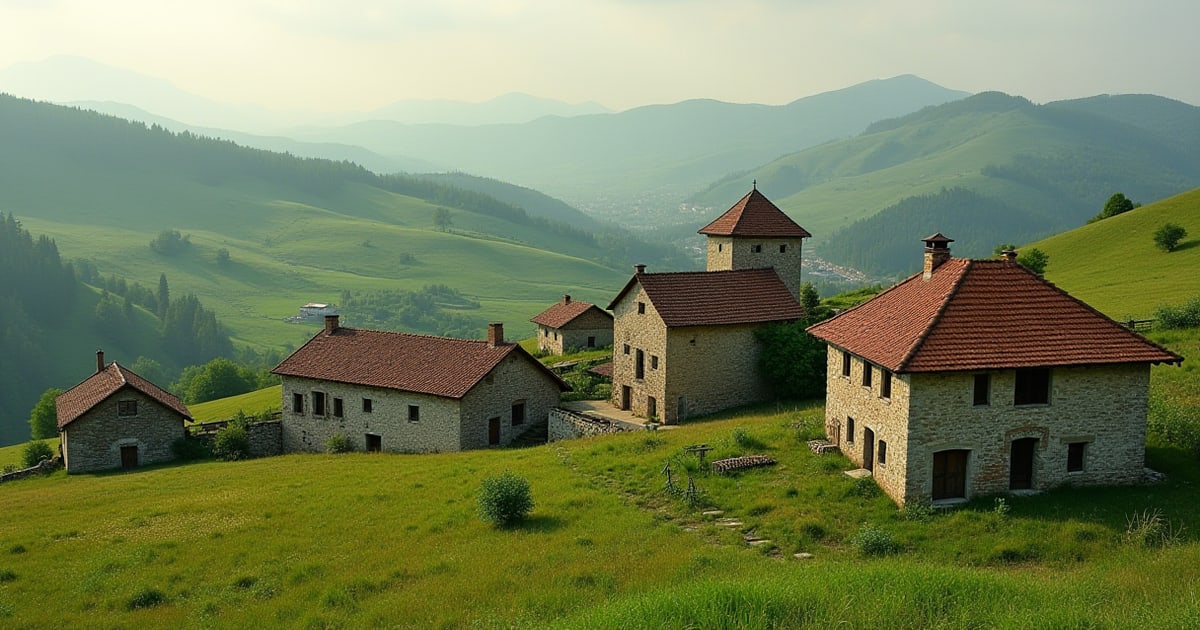
Banya is what estate agents mean when they say "10 minutes from the beach, half the price." It's a 173-person hillside village on the old Varna–Burgas road, about 7 km inland from Obzor and 5–6 km from Irakli — the wildest stretch of sand left on the Bulgarian Black Sea. If you want a cheap village house, deep quiet, and the sea close enough for an after-work swim, Banya is one of the best-value spots on the entire coast. If you need a pharmacy you can walk to, a rental market, neighbors under 60, or any commerce at all between November and April, skip this one and look at Obzor's guide or Sveti Vlas instead.
What it's like
Banya sits at about 185 m in the foothills of the Eminska planina, the last ridge of the Balkan Mountains before it drops into the sea at Cape Emine. The setting is genuinely lovely: forest and vineyards on all sides, a Natura 2000 zone, and the Via Pontica bird migration corridor overhead every spring and autumn. The village core is old Bulgaria — stone-and-timber houses, the 1769 church of St. Elijah (the village fair is every July 20, Ilinden), a mayoralty building from the early 1930s, and not a single apartment block. New construction is limited to individual villas and the small St. Vlad holiday complex about 1.5 km outside the village.
One myth to kill early: despite the name (banya means "bath"), there is no mineral spring or spa here today. The name is inherited from Palyo Banya, the original coastal settlement destroyed by pirate raids in 1760, after which survivors rebuilt the village hidden inland. The famous spa towns called Banya — near Razlog and near Panagyurishte — are entirely different places, and plenty of websites conflate them. Don't buy here expecting thermal water.
The history runs deep in other ways. Banya was a Greek village until the 1920s — 136 Greek families in 1890, all gone to Greece by 1925 under the population exchange, replaced by Bulgarian refugees from Aegean Macedonia and Asia Minor. Before 1944 it was a municipal center of over 2,000 people. Today it's 173 permanent residents, mostly elderly, plus roughly ten foreign families (British, German, Dutch, Australian), a few of whom live here year-round — leftovers from the 2005–2008 holiday-home wave.
The village's one genuine attraction is unexpected: the Gea Chelonia Foundation runs Bulgaria's only rescue and breeding center for land tortoises here, open to visitors as a small ecotourism site. In summer a yoga retreat operates on the edge of the village. That, a bar-restaurant, a couple of shops, and a small hotel is the complete list of things to do.
The season — and what winter really looks like
Summer transforms Banya the way it transforms every coastal village. Holiday-home owners arrive from May, the yoga retreat opens, the municipal bus runs about 14 times a day, and Irakli — 3–4 km of undeveloped, protected beach with no hotels behind it — is a 10-minute drive away. July and August here are honestly close to idyllic: cooler than the beach strip, quiet at night, and you're swimming before breakfast.
Then mid-October comes and everything contracts at once. The village drops back to ~170 people. One or two shops and the bar are the only open doors. Obzor, your service town, largely shuts down too — this is the pattern everywhere on the small-town Bulgarian coast, but Banya adds an extra layer of isolation because you're inland, uphill, and off the tourist grid entirely. Bus service thins out badly. At 185 m elevation you get real wind and occasional snow. If you overwinter here, you need a car that starts, a wood or pellet stove you trust, a full freezer, and a temperament that treats silence as a feature. Around ten households manage it. Be honest with yourself about whether you'd be the eleventh.
Property: buying and renting (2026)
Property is the reason Banya is on this site. In August 2026, imot.bg carries 74 active sale listings for the village — remarkably many for 173 residents — averaging €651/m², roughly half of Obzor's ~€1,199/m² seven kilometers away. Cross-checked against alo.bg (27 house ads, €636–1,270/m²), the numbers hold.
| Segment | Typical 2026 asking price |
|---|---|
| Fixer-upper (80 m² house, 400 m² plot) | from ~€25,000 |
| Liveable village house, 100–130 m², 400–1,900 m² yard | €66,000–105,000 |
| St. Vlad complex townhouse/villa, 2–3 bed | €55,000–67,000 |
| Renovated/new large house, 224–250 m² | €198,000–245,000 |
| New-build pool villa with Irakli Bay views, 131–135 m² | up to €444,000 |
| Agricultural/large plots, 5,000–10,400 m² | €7,000–26,000 (≈€1–5/m²) |
A few practical notes. There is no apartment market — the "2-bed" segment is townhouses in the St. Vlad holiday village from 2008, where the maintenance fee is reported around €350–500/yr depending on pool use; freestanding village houses have no fees at all. The €444k pool villas are asking prices at ~€3,300/m² — five times the village average — and have sat on portals for a while; treat the top end with skepticism. At the bottom end, budget seriously for renovation: many €25k–50k houses need roofs, wiring, septic work, and heating from scratch. Read the buying property in Bulgaria guide before you view anything — EU citizens can buy a house and its land outright, non-EU buyers usually need a Bulgarian company for the plot, and the diligence steps matter more in villages than anywhere else.
Renting first, the advice we give for every town, is nearly impossible here: imot.bg shows three rental listings total for the whole village, one of them a 284 m² furnished villa at €800/mo. If you want to test the area before buying, rent long-term in Obzor over a winter and drive up to Banya daily. That experiment costs a few thousand euros and can save you tens of thousands.
Everyday practicalities
Inside the village: a couple of small food shops, a bar-restaurant, a hotel, a post office, and the mayoralty. That is the complete inventory. No pharmacy, no doctor, no school, no bank, no fuel station.
Everything else runs through Obzor, 7 km down the hill: pharmacies, a medical center with private GP practices, supermarkets, restaurants, a police station, and the united school (Sv. Sv. Kiril i Metodiy), which runs through grade 10 — school-age kids commute down the hill, and the final grades mean Nesebar, Burgas, or Varna. There is no hospital nearby: the closest are in Burgas (~55 km) and Varna (~73 km). If you're on daily medication or have a condition that needs fast response times, weigh this section more heavily than the property table.
Day-to-day costs are as low as Bulgaria gets — village water, local produce, no complex fees — but run your own numbers with the cost of living calculator and the national cost of living guide, because heating a stone house through a windy winter is the line item newcomers underestimate.
Getting there and around
Burgas Airport (BOJ) is the gateway: ~48 km, about 45 minutes by car. Varna Airport is ~73 km, about 1h10. Both have year-round European connections, though winter schedules shrink.
Public transport exists but don't build a life on it. Municipal bus line 9 (Sunny Beach–Banya–Obzor–Byala–Varna) stops in the village roughly 14 times a day on the summer timetable; off-season expect a handful of runs. Intercity Varna–Burgas coaches stop at Obzor's bus station, 7 km away. In practice a car is non-negotiable — for shopping, for the doctor, for the beach, for winter sanity. See driving in Bulgaria and buying a car (annual vignette: €64.50).
Who it suits
- Renovators and bargain hunters who want a real house with land under €100k, 10 minutes from an unspoiled beach.
- Summer-base buyers splitting the year — the St. Vlad townhouses at €55k–67k are among the cheapest turnkey holiday homes near any decent Bulgarian beach.
- Genuine solitude seekers — writers, remote workers with Starlink-level self-sufficiency, people leaving a loud life on purpose. Run the residency wizard to sort out your paperwork route first.
- Not for families needing schools nearby, anyone without a car, people with significant health needs, or anyone who wants to rent before buying — there's nothing to rent.
If Banya feels one notch too remote, Kosharitsa offers a similar village-behind-the-resort formula with Sunny Beach's services ten minutes away, and Ravda keeps you on the sea itself.
FAQ
Does Banya have mineral springs or a spa?
No. The name is historical — it traces to the coastal settlement Palyo Banya, destroyed by pirates in 1760. The spa towns called Banya near Razlog/Bansko and Panagyurishte are different villages entirely. There is no bathable spring here in 2026.
What does a liveable house actually cost in 2026?
A habitable 100–130 m² village house with a yard lists at €66,000–105,000 on imot.bg and alo.bg. Fixer-uppers start around €25,000, but budget at least as much again for renovation. The village average is €651/m² — about half of Obzor's level.
Can I live in Banya without a car?
Realistically, no. Summer buses run ~14 times a day, but winter service is thin, and the nearest pharmacy, doctor, and supermarket are 7 km away in Obzor. Every year-round resident we'd point to drives.
Are there long-term rentals in Banya?
Essentially none — three rental listings for the entire village in mid-2026, one of them a large villa at €800/mo. If you want to trial the area, rent in Obzor or Byala for a winter instead.
How far is the beach?
Irakli, one of Bulgaria's last undeveloped beaches, is 5–6 km (about 10 minutes by car). Obzor's long town beach is 7 km. Sunny Beach and Nesebar are 15–25 km south when you want restaurants and nightlife.
Sources
- imot.bg — sale listings, Banya (Burgas province)
- imot.bg — rental listings, Banya
- alo.bg — houses and villas for sale, Banya
- Wikipedia (BG) — Banya, Burgas province)
- Wikipedia (EN) — Banya, Burgas Province
- bgselo.eu — history of Banya (Nesebar)
- Gea Chelonia Foundation — Tortoise Centre, Banya
- Visit Nessebar — village of Banya
- Nesebar Municipality — summer bus timetables
- Rome2Rio — Banya to Burgas Airport
- selo.bg — Banya village profile
- Luximmo — Obzor town info (services, hospital)
Got a question this guide didn't answer? Ask the community — we reply to every question.